
You Seem Pretty Sad for a Life So Worth Living (An Economic Perspective)


Hey, does the title sound familiar to you? Well, maybe you indeed heard it somewhere because… Olivia Rodrigo had just released a new album titled ‘You Seem Pretty Sad for a Girl So In Love’. Sounds a little cheesy no? So why don’t we just give it a little twist and make it econ-ic! You seem… pretty sad… for a life so worth living… and let’s break it down together.
Would you rather bawl in a Bentley or sob in a subway?
Sounds like an easy question? Had happiness been measured by how much money one could utilize, then bawling in a Bentley would sound like a wonderful way to spend life!
An Indonesian neuroscientist, dr. Dyu Hasan, agreed on the idea that happiness may align with how much money someone owns. Him in one of his interviews gave an example of Finland consistently ranks among the top 30 wealthiest nations globally and according to reports said country has ranked first in the happiest countries among the others (BBC, 2025). However, this later might be misunderstood by just merely judging the Finnish’ happiness is rooted in their high income.
John Helliwell, a Canadian economist and a founding editor for the World Happiness Report stated that people are much happier living where they think people care about each other, acknowledged by a study that found strangers in Finland are about twice as kind as people think. It is a wallet-experiment study that measured trust in strangers by losing wallets, and resulted in the rate of wallets returned was almost twice as high as people predicted. So if this experiment believes that the kindness of others was more closely tied to happiness than previously thought, how do we perceive the relation of money and happiness?
People might argue by bringing up Lesotho’s highest suicide rate due to poverty, with suicidal rate of 28 deaths per 100,000 people annually in the year of 2021 (WHO, 2024). However, South korea had the second highest suicide rate in the world in the same year despite being the 10th largest economy that year (Nikkei Asia, 2021). How do we interpret this data? There was a theory called the Easterlin Paradox that states an increase in a nation's wealth (GDP) over time does not necessarily lead to an increase in its citizens' reported happiness (Easterlin, 1974).

Graph 1. Regression Line Fitted to International Cross Section of Happiness and Real GDP per Capita
Source : IZA Institute of Labor Economics, 2020
This theory can be supported by observing Japan. In the 1980s, Japan’s economy escalated rapidly nevertheless, their happiness was relatively stable. Whilst afterwards, in the 1990s-2000s, their economic growth slowed but happiness started to improve instead. Easterlin later concluded that his paradox theory is caused by social comparison in people’s evaluations of their income, as the positive effect on happiness of growth in one’s income is undercut by the comparing habit in society. Hence, happiness can be increased even at fairly low levels of GDP per capita, by a strong social safety net as is strongly anchored in the Finnish people’s culture, and that happiness is not simply observed through the lens of someone’s wealth.
Why do we bother to even suffer? (1)
Maybe because they said… money can’t buy happiness (if you don’t have enough!)
In measuring someone’s happiness, people might observe from the observables— the physical suffering. The suffering of the rich are often understated as it’s always been easy to define the wealthy, the multimillionaires, the crazy rich Asians, the remarkable billionaires, you name it. They used to have many slaves, golden chariots, magical looking dresses for their daughters, a colossal garden, and a classic-but-luxurious looking porch. That hasn’t even budged a lot. Now the billionaires live with sports cars parked in their garage, a quick weekend vacay to Malibu, enormous houses with questionable-sized gates… Times may have changed but the symbols of wealth still seem remarkably similar.
On the opposite end of the scale, there are way too many options to describe the poor. Oh, could be the ones with dirty shoes, could be the skin-wrapped bone and unhealthy looking ones, could be the one with many kids who can’t afford going to universities. For the poor, problems are so much related with their physical needs like clothes, houses, healthy food, and the list goes on. But for the rich, as their physical needs are fulfilled, it is assumed that they are more happy.
Because of the assumption that money could solve their problems and sufferings, everyone spends their life chasing goals after goals, searching for the best career path. Some people start to live like programmed robots, living just to work instead of work to make a living. 9-5 starts to feel normal, then stretched sometimes to midnights for the days they need to work overtime. As soon as they get home, things start to make sense and they’ll ponder:
Why should I tire myself of cash that’ll turn to ash?
Why do we bother to even suffer? (2)
Or maybe… That’s just how the economy works!
Suffering is a part of the economy, and that is a harsh truth. Sometimes the real driver of people doing endless meetings is not their love towards the job, sometimes it is the deficiency in life. Some fathers work so that he can pay for his son’s tuition fee, some husband work to support his wife’s pride amongst the members of socialites through expensive bags scraped off of some animal’s skin, some women work just to prove the world she’s able to, some students do part-time jobs as they don’t want to burden their parents by asking for more, and so forth. Though to be fair, ever since forever humans do jobs for the purpose of eating. Nevertheless, to even worsen that, the world is getting richer, but unequally. As the rise in world population rises in 2025, along with each person’s yearly income increasing to €14,000 (in 2025 euros). However, the critical question is: For this growth, are the resources evenly shared?

Graph 2. Wealth is Distributed Inequally
Source: World Inequality Report, 2026
The graph depicts an inequality in the wealth distribution, stating that the global bottom 50% owns only 8% of total income and only 2% of global wealth while the top 10% owns largely 53% of income and 75% of wealth. Ironic how with the rising gap of wealth, people start to suffer even more just to survive the rising living cost. At this point, is it just how the economy works? Maybe, as Lionel Robbins in 1932 has defined economics as the science studying human behavior as a relationship between unlimited wants and finite resources. This later shifted economics from a materialistic study to more of analyzing one’s behavior and decision making under scarcity.
A bitter fact people don’t realize is, growth often comes from the very humanistic feeling of ‘not having enough’. Why do we invent cars? Because having a chariot is not fast enough. Why did we invent coffee machines? Because grilling coffees manually is too tiring, and there’s not enough time for that. Why is health care so well-developed? Because we think our lifespan is not enough. That’s why people are scared if they lack something, forgetting that… deficiency is the essence of humanity.
Have you ever wondered if we just… had it all?
Going back to a generalized assumption of how money would buy happiness if you had more and more, then does it cancel the nature of the economy that says we will always have limited resources? If money means happiness, billionaires would be the exception for economic principles. But in fact, even billionaires are still chasing something to fulfill their still unlimited needs. Are you familiar with the Diddy case? That notorious Diddy case? P. Diddy, despite having tons in his bank account, still has this very weird need that later traps him into a very questionable case that has ever relentlessly become a trending topic for a quite considerable time period. Or maybe the Epstein case? The Weinstein case? The Jeffries case? Oh we could go for days listing them! These billionaires are involved with cases with the reason that only God knows what. This proves that with us as human beings, we will never reach a point where we could say, ‘I’ve had it all.’
Supporting that idea, research stated that the 7.5% increase in the minimum wage in the U.K. in 2016, which only applied to those aged 25 and over aligned with drug stops and arrests outside business hours. Assuming that however the rise in income affects the amount of crime related to drugs, this symbolizes that happiness might not always be positively related to wealth owned by someone (IZA Institute of Labor Economics, 2025). This aligns with the diminishing marginal utility proposed by Alfred Marshall in his Principles of Economics (1890), shown by the graph below.

Graph 3. The Diminishing Marginal Utility of Income and Wealth
Source : economicshelp.org
As in the graph, say that one week one earns $10 as his weekly wage. Now his life standard would be based on that $10 per week and his satisfaction and marginal utility of using that amount of money will be the maximum amongst the other later weeks. Aight, let’s pump it up to $20 in the next month. He would then no longer be satisfied with just $10. As soon as he gets to thousands of dollars, $10 wouldn’t feel like adding it up. The same thing goes with the utility of the material itself. A second car’s extra benefit is much diminished compared to the first car. Either way, a person can only drive one at a time. Though a car collector may get some joy from having a collection, the extra utility of the nth car is significantly lower than a working person who has just one car to get to work. Pretty much, a physical utility is different from one’s internal well-being exposed by the data following.
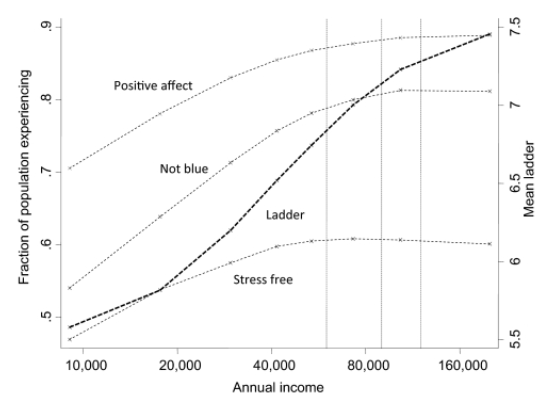
Graph 4. High Income Improves Evaluation of Life, but Not Emotional Well Being
Source: National Center for Biotechnology Information (NCBI), 2010
On a well-being perspective, another research conducted by the Gallup Organization of 450.000 US residents in 2008 to 2009, found that high income does not necessarily improve emotional wellbeing and that there is a diminishing return of happiness in the rising of one’s income. On the y-axis, ‘positive affect’ symbolizes the fraction of happy people, ‘not blue’ is the fraction of people who did not report worry and sadness, ‘stress free’ is the fraction of people who did not report any stress. The graph tells us that by the time someone earns $75,000, he’s reached a threshold which further increases in income no longer improves individuals’ ability to do what matters most to their emotional well-being.
Said research demonstrated that a goal of contentment is beyond money, the standard of happiness of one might vary from their experiences, and the system benefits from it. In the Experience Economy Theory, it is proposed that memorable, personal experiences are the next logical step in the evolution of economic value (Pine & Gilmore, 1999). To satisfy people, businesses need to sell from the experience they can offer and make customers go ‘Wow!’. Back in the days, birthdays were celebrated with just a homemade cake, later it was scaled up to inviting families over for an inter-family event, and now it is very common for people to throw huge parties to celebrate their birthdays that’ll make the guests go ‘Wow!’ and raise the dignity of the parents’. The experience theory lowkey stated that people can never be just happy after they get used to something.
With all the discussion above, maybe, just maybe… the question that aims for happiness is not to make someone choose between a Bentley or a subway. Maybe, happiness is more than how fat our bank account is or how skinny a person looks due to not being able to afford food. It’s deeper, rather fundamental, and unravels the very insecurity of a human being. Happiness would not exist in one’s dictionary had he not valued the things he has in the present moment. It’s beyond money, for that economics is principally far from materialistic. That human is a lump of scarcity, only an otherworldly being could fulfill. Hence, whatever we chase in life, wherever our career leads us to, whichever fate we accidentally choose, whoever people we’re bumping into in life, we should root back to our realization of: Life means so much more than just a chase of imaginary standards, and that happiness is attainable had one just realized how much grace he’s received.
Contentment is natural wealth, luxury is artificial poverty. - Socrates
References:
Boyd & Greenall. (2024, October 17). Finland named as the happiest country for eight year. BBC News. https://www.bbc.com/news/articles/cr72xep44kdo
Easterlin & O’ Connor. (2020). The Easterlin Paradox. IZA Institute of Labor Economics. https://docs.iza.org/dp13923.pdf
George E. G. Catlin. (1933). Review of An Essay on the Nature and Significance of Economic Science., by L. Robbins. Political Science Quarterly, 48(3), 463–465. https://doi.org/10.2307/2143162
Global Finance Magazine. (2025, September 3). Richest countries in the world 2025. https://gfmag.com/data/richest-countries-in-the-world/
Kahneman & Deaton. (2010). High income improves evaluation of life but not emotional well-being. National Library of Medicine. https://pmc.ncbi.nlm.nih.gov/articles/PMC2944762/
Kerry L. Papps. (2025). Why Higher Pay Leads to More Crime. IZA Institute of Labor Economics. https://docs.iza.org/dp17989.pdf
Kim, J. (2022, January 25). South Korea GDP growth hit 11-year high in 2021 on strong exports. Nikkei Asia. https://asia.nikkei.com/economy/south-korea-gdp-growth-hit-11-year-high-in-2021-on-strong-exports
Marshall, A. (1890). Principles of economics (8th ed.). Online Library of Liberty. https://eet.pixel-online.org/files/etranslation/original/Marshall,%20Principles%20of%20Economics.pdf
Pine & Gilmore. (2011). The experience economy (Updated ed.). Harvard Business Review Press. https://dokumen.pub/the-experience-economyupdated-ed-updateded-9781422161975-1422161978.html
World Health Organization. (2024, January 8). Suicide mortality rate (per 100 000 population). https://data.who.int/indicators/i/F08B4FD/16BBF41
World Inequality Database. (2026). Global economic inequity. https://wir2026.wid.world/insight/global-economic-inequity/


Manfaatin situasi buat promosi buku 🤣🤣🤣
Good read!
love it!